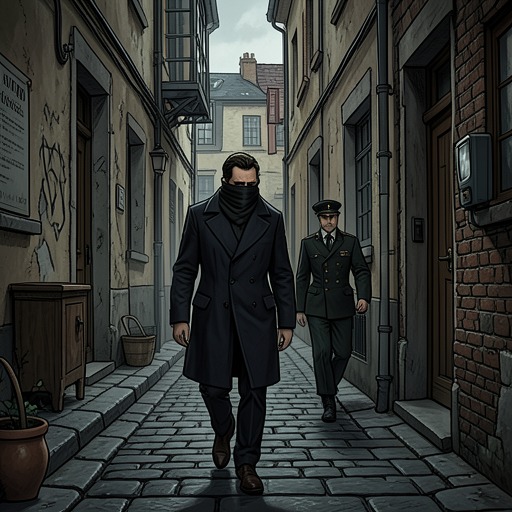
Paul Doll—Dieter Kruger
The Zone of InterestPaul Doll’s relationship with Dieter Kruger begins inside the machinery of political imprisonment and returns years later as a private history of betrayal. Doll was among Kruger’s jailers at Dachau, but the connection was not merely that of guard and prisoner: Doll helped identify Kruger to the authorities, and Kruger’s concealed fate became a subject Doll continued to pursue. The story’s disclosures recast that pursuit as a knot of political violence, complicity, and personal rivalry.
Identity and Background
In March 1933, after the Reichstag Fire, four thousand left-wing notables were arrested, tortured, and imprisoned. Kruger was among them. He was sent to Dachau, where Doll served as one of his early jailers, then a corporal. The relationship thus took shape within a system in which political identity determined who could be confined and who could exercise power over the confined.
The two men’s positions were sharply unequal, but their histories were also linked by Doll’s own record of paramilitary violence. In 1923, Doll’s unit identified a supposed traitor in Parchim. Martin Bormann later recalled that he had passed on permission for a beating, after which Doll and his men stayed too long in a pub and went too far in the woods. Bormann served a year; Doll received a ten-year sentence and served five. Bormann suggested that Doll had partly taken the fall for him. The earlier episode supplies a grim precedent for Doll’s later entanglement with Kruger: violence is treated as a deed that can be delegated, concealed, and paid for through imprisonment, without ever becoming morally settled.
From Jailer to Informer
Doll’s authority over Kruger did not end with his role as a guard. Bormann reveals that Doll was never a Communist but was a reliable Nazi, and that he was in the pay of the Browns. He also says Doll fingered Kruger to Cell H. This disclosure makes Doll’s relationship to Kruger more than an encounter between a jailer and a political prisoner: Doll helped deliver Kruger into the hands of a secretive apparatus, turning the unequal relationship into an act of betrayal.
The account does not provide a full chronology of Kruger’s transfer or the precise circumstances of his death. Instead, its fragments emphasize how little can safely be said in public. When Doll is asked what he will tell Kruger, he proposes the familiar formulation that Kruger was shot while trying to escape. Bormann immediately clarifies that this is only a form of words: it means Kruger is dead. The official explanation is not evidence of an escape attempt; it is a phrase that conceals the reality of a death while making it sound administratively legible.
The Past Reopened
Years later, Doll’s interest in Kruger resurfaces in conversation with his nephew, Angelus Thomsen. Thomsen says that he is after some Communist, and Doll identifies Kruger before Thomsen has supplied the name. Thomsen’s surprise signals that Doll’s recognition is not casual. The old prisoner has remained vivid enough in Doll’s mind for a vague reference to a Communist to summon him at once.
Bormann treats the subject as darkly amusing, but his account links it to another source of Doll’s investment: Hannah Doll had been involved with Kruger before her marriage to Paul. Bormann asks whether Doll is concerned because Kruger had been with Hannah first. That explanation is presented as Bormann’s interpretation, not as a settled account of Doll’s motives. It nevertheless places sexual rivalry beside political denunciation, making the private and political histories difficult to separate. Doll’s interest in Kruger’s fate may involve more than one grievance, while the conversation offers no clear confession from Doll that would resolve the mixture.
Concealment and Significance
Bormann claims that fewer than half a dozen men in the Reich know what happened to Kruger and delays telling Thomsen the whole story. His withholding makes the relation itself part of a larger secret: Kruger is dead, Doll helped betray him, and the fuller circumstances remain restricted knowledge. The revelation arrives not through a formal inquiry but through intimate conversation, as Bormann moves between family familiarity, amusement, and the disclosure of murder concealed beneath official language.
The relation also echoes the habits of euphemism surrounding the camp. At a reception for arrivals, Doll promises recuperation, farm work, a warm shower, rooms, tea, and food, while the actual journey ends in the machinery of the camp. In another account, prisoners describe being coached to tell arrivals that they are eighteen and have a trade, a lie intended to affect selection. These episodes do not establish the precise circumstances of Kruger’s death, but they illuminate the world in which Doll’s false escape story operates: words of reassurance and routine can conceal coercion and killing. His history with Kruger is therefore both personal and institutional—a former jailer’s connection to a prisoner, an informer’s betrayal, and a death obscured by a formula that turns murder into procedure.